
Columbus County Recent Arrests
The Columbus County Sheriff's Office In Custody page is the official starting point for any search. It names the Columbus County Detention Center report. It links to dated PDF files on Dropbox. There is no name search. The sheriff does not describe the folder as a live feed of recent arrests, and the newest file can lag months behind the current jail population. Always check the report date. A missing name could mean the file is stale or the booking is still underway. For a specific booking record, call the detention center or ask the records custodian.
Two related pages answer narrower questions. The 24 Hour Arrests page explains the same-day fallback where no official 24-hour list exists. The Arrest Log page tracks multi-day reports and local news archives. Each keeps a separate focus. Together they cover the recent arrest record from first booking onward.
| View | Best use | Key limit |
|---|---|---|
| In Custody report | Current county detention snapshot | No stated refresh time or photo policy |
| Same-day check | Very recent booking confirmation | No separate official 24-hour feed found |
| Multi-day blotter | Older date windows and local reporting | Republished items are not complete official archives |
| eCourts | Case events and disposition | Not a custody roster |
Arrested Overnight in Columbus County
An overnight arrest does not hit the public report at once. Timing explains most of it. Arrest time, jail arrival, booking time, and publication time are separate events. Pull the newest dated sheriff file first. Then call the detention line at (910) 640-6628 if the folder is old or the booking has not appeared. That number comes from a facility directory. Confirm it with CCSO before depending on it. For live custody changes, the VINELink Check page explains alert registration, though NC SAVAN leaves out some police-only detentions and anyone who bonds out before entering the jail. A missing name proves neither release nor closure.
Search Columbus County Jail Roster
Picture the roster as a document shelf. Open the sheriff's In Custody page, follow its Dropbox link, and compare report dates to find the newest file. There is no landing-page filter. Name, booking number, charge, and date all have to be searched by hand inside the PDF viewer, and only when the file holds searchable text. Keep arrest time separate from booking time. Release and bond status read as a snapshot that can shift after court action.
| Field to check | Why it matters |
|---|---|
| Report date | Shows whether the document is recent enough for the question |
| Booking identifier | Separates people with similar names |
| Arrest and booking times | Explains transport or intake lag |
| Arresting agency | Identifies the office that owns the arrest report |
| Charge and bond | Records intake charges and then-current bond |
| Release or custody status | Shows the status captured when the report was made |
- Open the official county page and use its report-folder link.
- Choose the newest file only after reading its date.
- Compare identifying details and the booking number where shown.
- Confirm a stale, missing, or conflicting entry with detention staff.
- Use eCourts for the later charge and disposition.
Booking photos are not confirmed on the official landing page. Nor does it state how long entries stay up. The official-branded Columbus County Sheriff app lists inmate search among its features, alongside alerts and Most Wanted. Use it as a backup. Its listing promises no faster data and no photo gallery. The roster files remain the primary source.
The official In Custody landing page displays the link that leads to the county detention report. That report is where the county custody list lives.
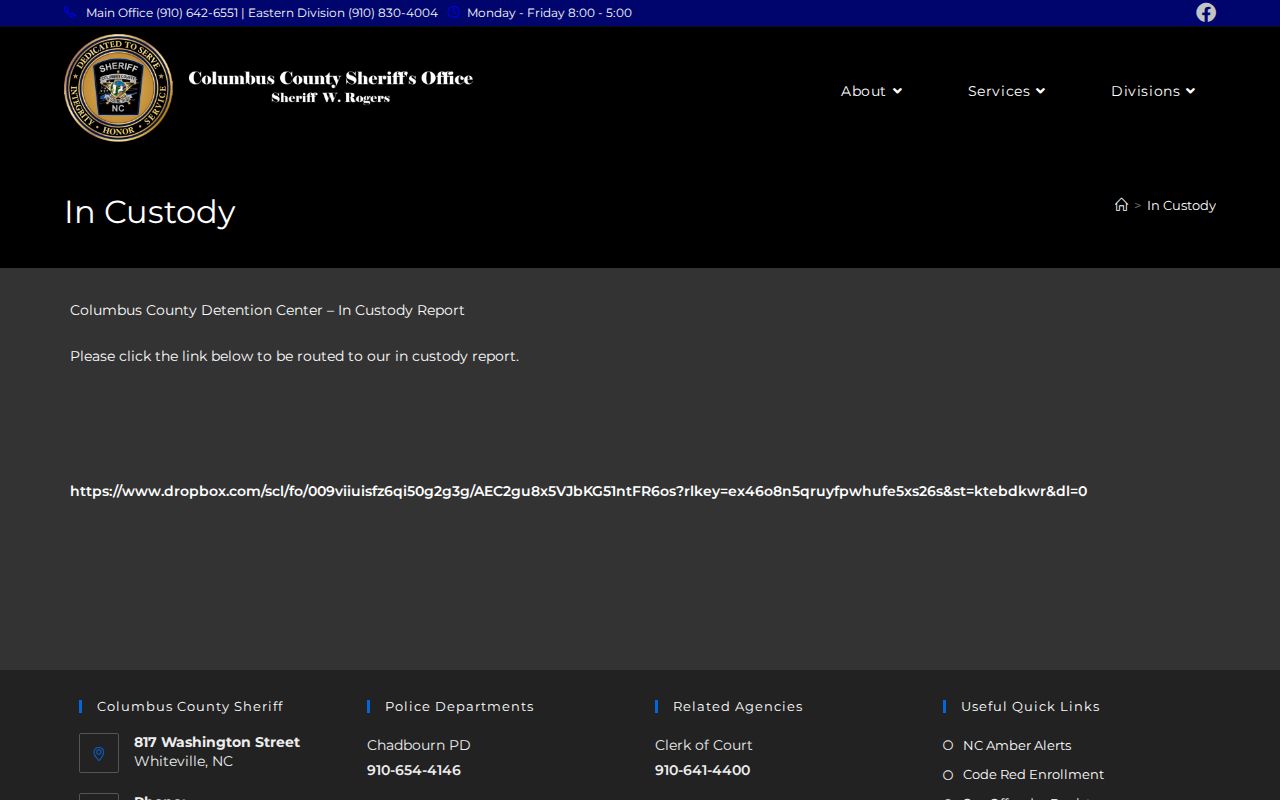
The capture helps distinguish an outbound report link from a live searchable roster.
Publishing Columbus County Bookings
Local news can help locate a date window. Official sources lead, though, because the sheriff and the courts own the actual record. Aggregators may leave copied booking fields standing long after custody changes, so confirm everything with the originating office.
| Channel | Official? | Photos | Access |
|---|---|---|---|
| CCSO In Custody | Yes | Not confirmed | Dated report folder |
| Sheriff app | Official-branded | Not promised | Google Play |
| NC SAVAN | Yes, state | No gallery | Custody search and alerts |
| Columbus County News | No, local news | Story dependent | Public Safety section |
| RecentlyBooked | No | May display | Unofficial county page |
| Busted Newspaper | No | May display | Unofficial state directory |
| Mugshots.com | No | May display | Unofficial state directory |
Private databases have real limits. RecentlyBooked's county page and its peers can omit records, duplicate names, or keep old status labels long after a Columbus County arrest clears custody. Counts change. So do update stamps, and no figure there deserves to be quoted as permanent. Arrests.org and Mugshots.zone list no Columbus County section, so neither counts as a local source.
The unofficial RecentlyBooked county section shows the gap.
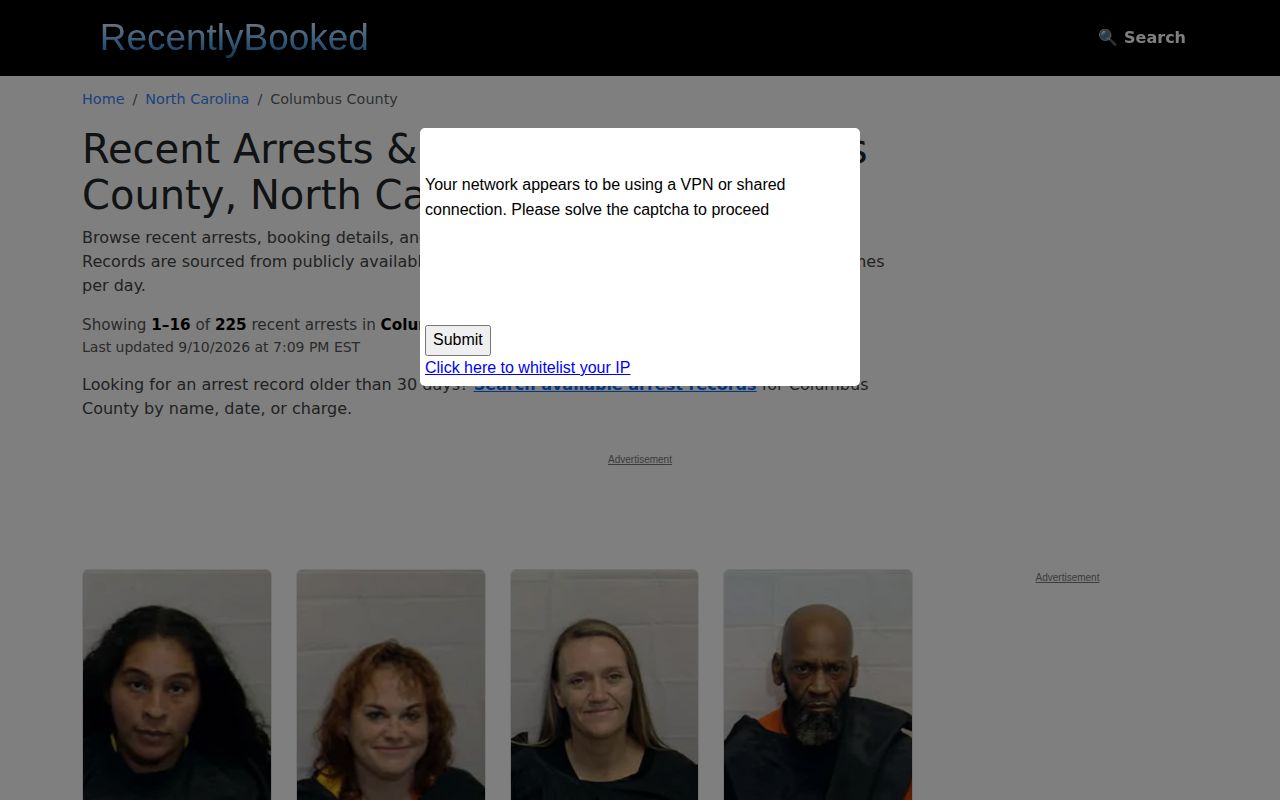
This capture is time-sensitive and does not establish current custody or guilt.
Recent Arrests by Columbus Cities
City police records start with the arresting department. After county custody begins, the shared detention reporting path takes over. It covers nearly everyone arrested in Columbus County. Whiteville Recent Arrests covers the Whiteville Police Department and its separate records route. Tabor City Recent Arrests explains the town police contact and the handoff into county booking. Chadbourn Recent Arrests separates police sources from the town's crash-report system. No live arrest log exists at the city level. The county path fills the gap.
What Columbus Arrest Records Show
A booking record documents intake into custody. A June 2026 CCSO report, republished by local media, showed the typical fields. Name and age appeared. So did charge, bond, arresting agency, status, arrest and booking times, release date when applicable, and an identifying number. Still, a republished sample is only a sample. It shows the known format without guaranteeing every field in each current official PDF.
| Record field | Meaning |
|---|---|
| Name and booking ID | Identity and jail-side reference for the entry |
| Arrest date and agency | When custody began and which office made the arrest |
| Booking date | When jail intake was recorded |
| Charges as booked | Charges at intake, not findings of guilt |
| Bond | Then-current release condition, subject to change |
| Release or status | Custody state at the report's snapshot |
| Photo | Identification image only if that record lawfully exposes one |
| Court information | Follow-up details that should be checked in eCourts |
Booked, released, and convicted are three different things. A booked person has finished jail intake. A released person has left that custody snapshot under the conditions in force at the time. Whether a case ends in dismissal, amendment, plea, or trial shows up only on the court docket.
Columbus County Booking Photos
Columbus County booking photos sit in a gray zone. The sheriff's office does not advertise them in its public custody reports. North Carolina law lets agencies take identification photos during qualifying arrests under G.S. 15A-502, yet nothing in that statute requires the photos to be posted online. A picture can sit in an agency file forever without ever reaching a public roster. Anyone with a lawful, purpose-neutral reason for needing one can ask the CCSO records custodian directly. The custodian still holds power to withhold photos tied to juveniles, victims, witnesses, confidential sources, or active investigations.
The NC Department of Adult Correction search covers a separate world of state prison and supervision records. It skips ordinary county-jail inmates, and not every result there includes a photo either. Private sites publish copied images, but their habits say nothing about CCSO policy. The official custodian remains the real authority on any Columbus County booking photo.
Request Columbus County Arrest Records
The Columbus County Sheriff's Office posts no dedicated online request form, fixed fee, or guaranteed turnaround for booking records. So start with the records custodian. The sheriff's office sits at 817 Washington Street in Whiteville, and county detention references also list 805 Washington Street. Call (910) 642-6551 first. That one call confirms the right delivery route, current hours, and any reproduction cost.
- Give the full name and any known birth date or booking identifier.
- Provide a narrow arrest or booking date range.
- Name the exact item: arrest report, booking sheet, custody entry, release record, or booking photograph.
- Ask for electronic delivery and an itemized estimate before chargeable work.
- If information is withheld, ask for the legal basis and consider narrowing the request.
North Carolina's public-records statutes, G.S. 132-1 and G.S. 132-1.4, set the frame for a request. They promise neither an instant reply nor every format free of charge. Statutes or court orders can justify redaction or withholding. A denied photo does not mean no record exists behind it.
Eligible cases can go through the North Carolina Judicial Branch expunction process at the clerk's office where the matter was handled. Once a court grants a correction, sealing, or expunction, contact each private publisher through its own free channel. RecentlyBooked offers a free correction and removal policy, and Busted Newspaper runs a free request route too. Skip paid services that only promise suppression. If the source changed but a stale Google result lingers, use Google's outdated-content refresh once the source itself is fixed.
North Carolina Records Law
G.S. 132-1 broadly defines public records. G.S. 132-1.4 treats criminal-investigation material more specifically. It makes listed categories public, including arrest circumstances and identifying facts, while preserving exceptions for protected people and investigative needs. Proposed booking-photo bills from 2021 and 2023 were not enacted, so they are not current removal law.
Retention and web display are also distinct. The state sheriff schedule assigns different rules to criminal histories, identification photographs, case files, detention records, incarceration records, and weekly lists. An identification photo outside a case file may follow a three-year rule, while a photo inside a case file follows that case category. Some felony case histories have far longer periods. A weekly list may be replaced when obsolete even though the underlying arrest record remains with the custodian.
Public access does not erase those category lines. Juvenile files have special rules, and information about victims, witnesses, confidential sources, or an active investigation may be protected. A requester should describe the exact record and date range instead of asking for every file tied to a name. That gives the custodian a clearer task and makes any redaction easier to explain. When an agency supplies only part of a record, ask which statute or court order controls the withheld part. The answer may differ for an arrest report, a detention entry, a booking photograph, and the later court file.
Start an old-record search with CCSO, the municipal police department that created its own report, or the Clerk of Superior Court. The NC State Archives local-government program can help determine whether an older series transferred or remains locally managed. Do not assume that an absent web PDF was destroyed.
The official arrest-photo statute shows the legal authority for identification photographs.
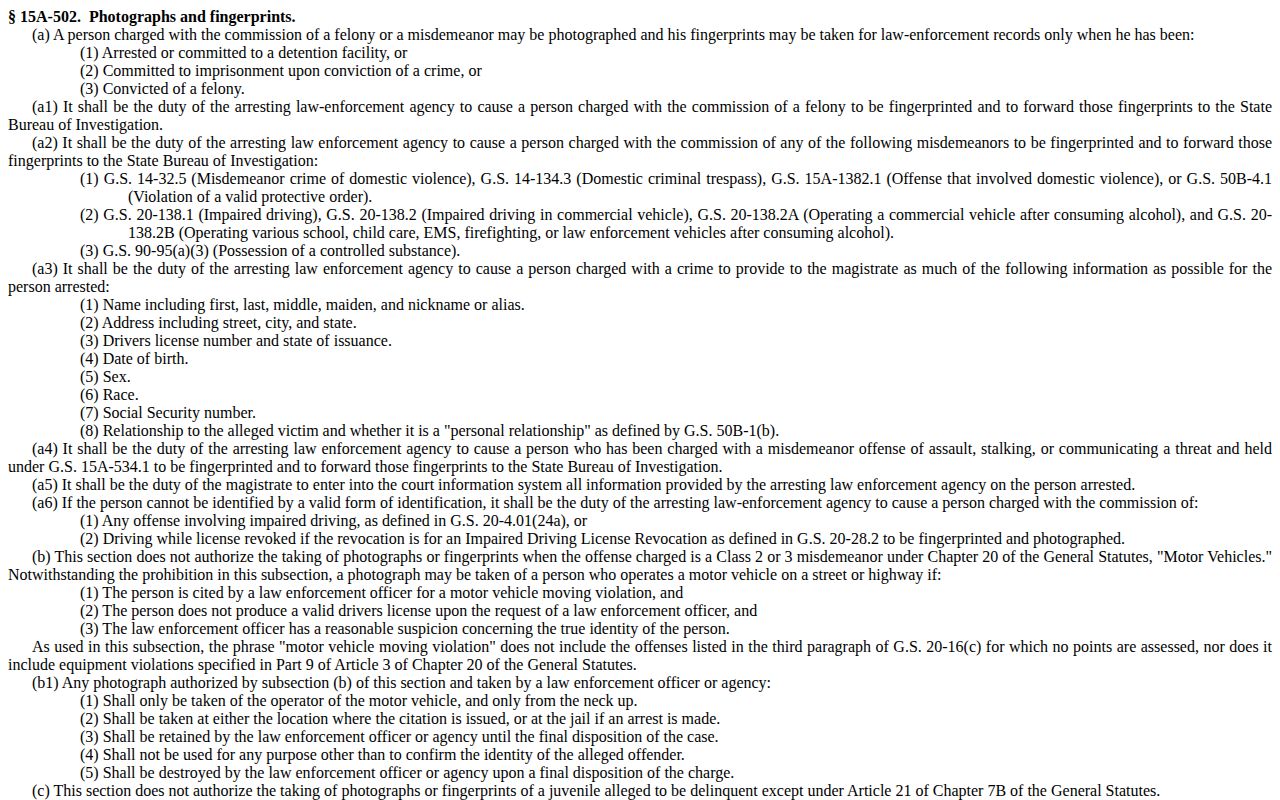
The text supports photo collection in the arrest process, not a mandatory public gallery.
Columbus Warrant and Wanted Notices
The official CCSO wanted page organizes its notices under Most Wanted and outstanding child-support-warrant headings. Its linked warrant destination offers no stable searchable list. There is no count or refresh schedule. Do not read current warrant status out of an old page or the jail report. Confirm instead. The sheriff answers at (910) 642-6551, and the Clerk of Superior Court at (910) 641-4400. The magistrates answer at (910) 641-4519. A returned warrant may enter the public court record. An unserved warrant and a completed arrest are distinct events.
Never approach or try to detain a wanted person. Tips go through the sheriff's official tip form, and emergencies belong with 911. Anyone checking a warrant that may carry their own name should talk with a North Carolina lawyer. The court can advise a safe, lawful path forward. The sheriff's wanted page remains the official starting point for its published notices.
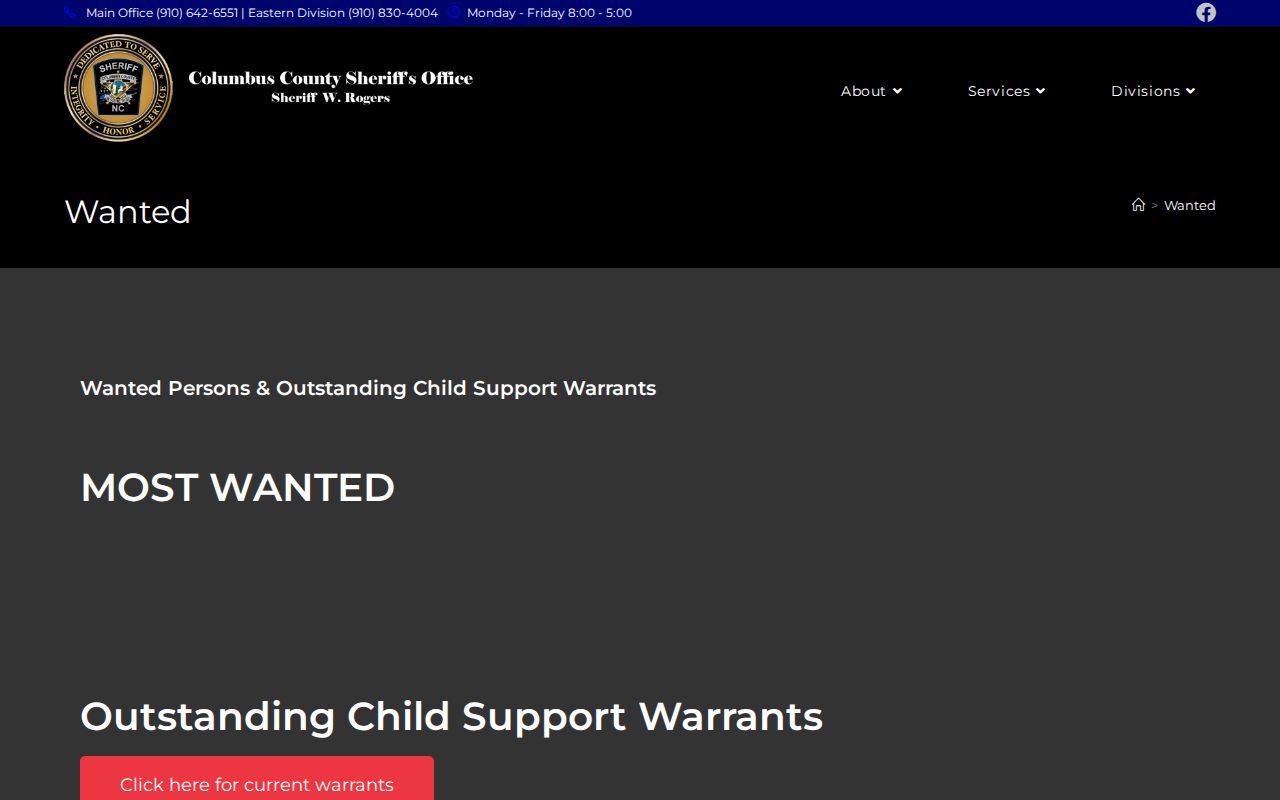
The capture documents the available headings without presenting a gallery of people.
After a Columbus County Arrest
A booking is only the opening chapter. What happens next unfolds in court. The North Carolina eCourts Portal is where to follow it in Columbus County. Look up a case by party name, case or record number, or citation. A magistrate typically handles the first appearance and sets bond there. Later hearings can change everything. Charges may be amended, a case dismissed, or a plea and judgment entered. That recorded outcome is called the disposition, and no booking report can predict it.
A Columbus County arrest opens a court case. The docket shows what happened next. The Clerk of Superior Court keeps those files.
Local access took a turn in 2020. WECT reported that CCSO kept sending arrest reports to media but stopped emailing incident reports. That split explains a lot. A booking summary, an incident narrative, and a court file in Columbus County can each have different availability, and none of them stands in for the others.
Custody Beyond Columbus County
County custody is not the whole picture. The North Carolina Department of Adult Correction search covers state prison, probation, and parole populations. Its reach stops at those three groups. The agency states plainly that ordinary county-jail inmates are left out. Someone booked in Whiteville may never touch that system. Someone serving a state sentence may vanish from the county's current report. NC SAVAN links some county and state custody alerts, though it lists its own exclusions. These gaps matter when a person moves beyond Columbus County custody.
Federal inmates call for a different tool. The Federal Bureau of Prisons locator reaches records back to 1982. It reports federal location or release status. It posts no booking-photo gallery and answers no county questions. The ICE detainee locator handles immigration custody, using an A-number or exact biographical details. It excludes anyone under 18. The Marshals Service rents local jail space for federal detainees. It confirms little and releases no photographs. For a straight name-or-number check, the official BOP locator stays the right starting point.
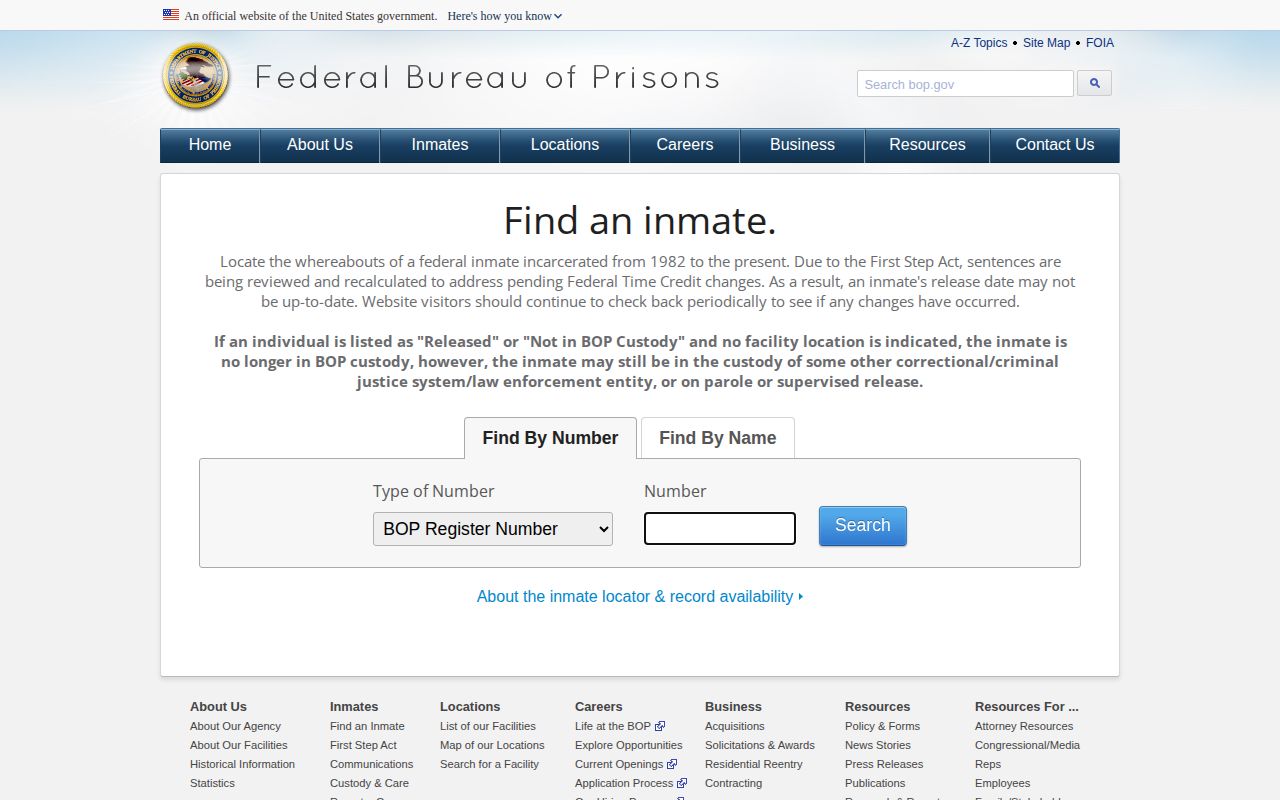
The interface should be used only after confirming that the matter is federal.